
Our Theory of Change - Cooperative Economics + Personal Transformation
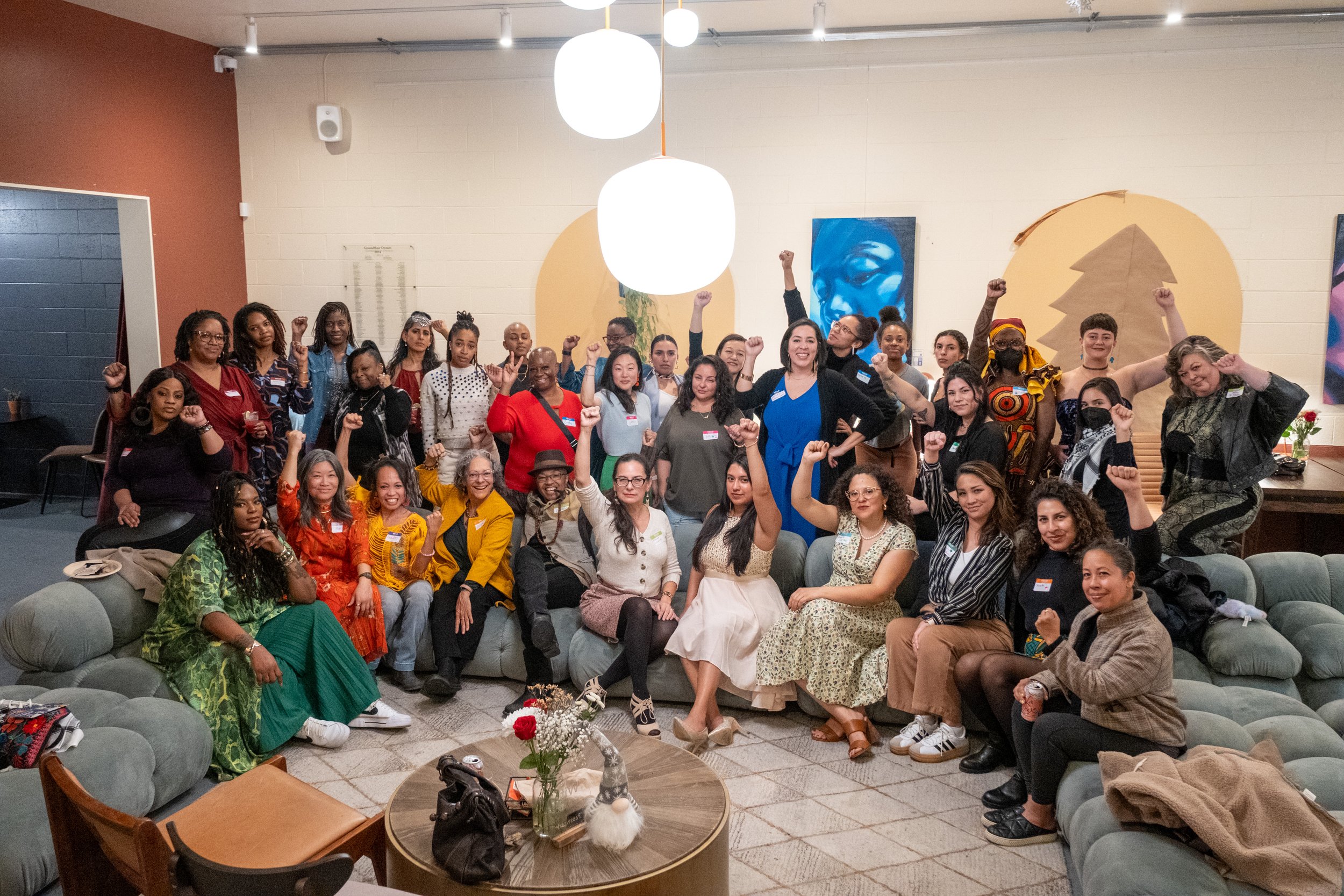
The current economy continues to disproportionately disadvantage women of color and their communities, as it is built on a foundation of racial capitalism, an economic system rooted in plantation slavery. In episode two of The 1619 Project podcast, “The Economy That Slavery Built,” Nikole Hannah-Jones highlights how many modern management and economic practices stem from the extractive labor systems of slavery.
This extractive approach is evident in the dominant narrative of business success in the U.S., where entrepreneurs are encouraged to sell their companies to large corporations for significant sums. However, these corporations are primarily controlled by wealthy white men whose generational wealth was built on the exploitation of Black labor, Indigenous lives, and natural resources. While a Black entrepreneur selling their business for millions is often seen as a marker of success, this cycle reinforces the racial wealth gap by keeping wealth concentrated in the same hands, rather than redistributing power and ownership.
At Just BE, we are committed to exploring alternative, ancestral business models that challenge these systems and create pathways for shared ownership and economic sovereignty rooted in community.
To bring this vision to life, personal transformation is essential. We are all shaped by oppressive systems and immersed in the dominant culture of what bell hooks named “imperialist white supremacist heteropatriarchy.” Without intentional healing, even as entrepreneurs, we risk replicating exploitative work environments and systems. Unlearning ingrained behaviors such as overworking, undervaluing labor, and prioritizing profit over people is a necessary step.
This is where somatic healing becomes foundational.
To build a world where Black, Indigenous, and Women of Color thrive in cooperative economics together, we must confront and heal the deep layers of generational and economic trauma that shape our lives. At Just BE, we turn to Somatics, a body-based healing practice that helps us grow our capacity for trust, collaboration, and authentic relationship building.
Through somatic work, we learn to interrupt embodied survival patterns that no longer serve us, making space for new ways of being rooted in justice, connection, and possibility. It’s how we begin to feel, and not just imagine, that a liberatory, equitable, and collaborative future is possible.
When we can sense that freedom in our very tissues, even during conflict or uncertainty, we’re better able to co-create new ways of doing business, leading, and living, together.
True social entrepreneurship is a path toward collective liberation. It calls us to heal, to empower one another, and to redefine what it means to truly thrive.
——————————————————————
Works Cited
Guy-Sheftall, Beverly. “Black Feminist bell hooks’s Trailblazing Critique of ‘Imperialist White Supremacist Heteropatriarchy.’” Democracy Now!, 17 December 2021, https://www.democracynow.org/2021/12/17/bell_hooks_legacy_beverly_guy_sheftall. Accessed 8 March 2024.
Guynn, Jessica. “Black executive leadership is growing but white men still rule.” USA Today, 16 February 2023, https://www.usatoday.com/in-depth/money/2023/02/16/white-men-corporate-america-diversity/11114830002/. Accessed 8 March 2024.
Hannah-Jones, Nikole. “‘1619,’ a Podcast From The New York Times.” The New York Times, 23 January 2020, https://www.nytimes.com/2020/01/23/podcasts/1619-podcast.html. Accessed 8 March 2024.